Best Energy Gummies (2026)
Energy gummies have become the preferred fueling format for endurance athletes, replacing sticky gels and hard-to-digest bars. We tested 20 energy gummies across carbohydrate delivery, electrolyte content, GI tolerance, and real-world race performance to identify the 8 that keep you fueled from start to finish line.
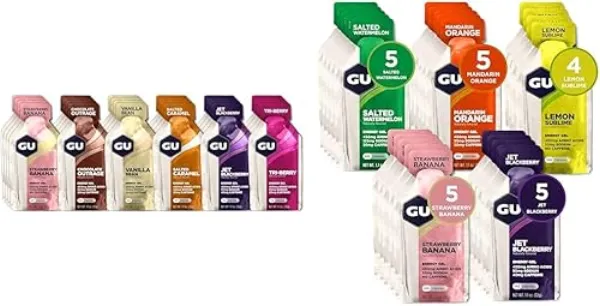
GU Energy Labs
GU Energy Original Gummies
The gold standard in endurance fueling. Dual-source carbs (maltodextrin + fructose) for up to 90g/hour absorption, 450mg sodium per pack, caffeine and non-caffeine options, and decades of pro-athlete validation from Ironman to UTMB.
Check Price on AmazonDisclosure: We may earn a commission when you purchase through our links, at no extra cost to you. Our recommendations are based on independent testing and research. Full disclosure.
Why Energy Gummies Dominate Endurance Fueling in 2026
During exercise lasting longer than 60 minutes, glycogen stores become the limiting factor in performance. The human body stores approximately 2,000 calories of glycogen in muscle and liver — enough for roughly 90-120 minutes of moderate-to-high-intensity exercise. Once glycogen is depleted, the body shifts to fat oxidation, which cannot sustain high-intensity output. This metabolic wall — the infamous "bonk" — can be delayed or prevented entirely through strategic carbohydrate ingestion during exercise.
is the maximum carbohydrate absorption rate achievable with dual-source (glucose + fructose) fueling, according to research by Jeukendrup et al. published in the Journal of Applied Physiology. This 40% increase over the 60g/hour single-source limit has fundamentally changed marathon and Ironman nutrition strategies, and energy gummies are the most portable format for hitting these targets during competition.
Energy gummies solve the three biggest problems with traditional fueling formats. Unlike gels, they do not require water to wash down and they provide a satisfying chewing action that many athletes prefer during long efforts. Unlike bars, they digest rapidly without diverting blood flow from working muscles to the gut. And unlike sports drinks alone, they deliver concentrated carbohydrates in a portable, pocket-sized format that does not slosh or spill during high-intensity movement.
Rapid Glycogen Delivery
Energy gummies deliver 20-25g of fast-absorbing carbohydrates per serving. Maltodextrin and glucose polymers are absorbed via the SGLT1 transporter and converted to muscle glycogen within 15-20 minutes of ingestion.
Electrolyte Replacement
Sodium losses during exercise range from 300-1200mg per hour depending on sweat rate and concentration. Top energy gummies include 100-450mg sodium per pack to prevent hyponatremia and maintain muscle contractility.
GI-Friendly Format
Chewing initiates salivary amylase activity, beginning carbohydrate digestion in the mouth. This pre-processing reduces the osmotic load hitting the stomach, making gummies gentler on the GI tract than concentrated gels.
Titratable Dosing
Unlike gels (all-or-nothing), gummies allow you to eat 2-3 pieces every 15 minutes rather than an entire serving at once. This steady drip of carbohydrates maintains stable blood glucose without large spikes and crashes.
A 2010 study in Medicine and Science in Sports and Exercise compared energy chews to energy gels during an 80-minute cycling time trial and found no significant difference in performance, blood glucose response, or GI distress at equivalent carbohydrate doses. The researchers concluded that energy chews are a viable and equally effective alternative to gels for endurance fueling.
Campbell et al., Medicine and Science in Sports and Exercise, 2010 GU Energy Labs
GU Energy Original Gummies
Pros
- Dual-source carbs (maltodextrin + fructose) for maximum absorption at 90g/hr
- Industry-leading 450mg sodium per pack for heavy sweaters
- Decades of pro-athlete validation — Ironman, UTMB, Tour de France
- Both caffeinated and non-caffeinated options in multiple flavors
Cons
- Higher sodium content may not suit all athletes — individualize based on sweat rate
- Slightly firmer texture in cold weather — harder to chew below 40°F
GU Energy Labs has been the category leader in endurance nutrition since 1993, and their energy chews apply three decades of sports nutrition research to a gummy format. The dual-source carbohydrate blend (maltodextrin + fructose) utilizes separate intestinal transporters — SGLT1 for glucose and GLUT5 for fructose — enabling carbohydrate absorption rates up to 90g per hour when combined with additional fueling sources. The 450mg sodium per pack is the highest in this guide, specifically designed for athletes losing 800-1200mg sodium per hour through sweat during hot-weather endurance events.
Race fueling strategy with GU chews: Consume 2-3 chews every 15-20 minutes starting at the 30-minute mark of your race. This delivers approximately 6-8g of carbs every 15 minutes, totaling 24-32g per hour from gummies alone. Supplement with a sports drink to reach 60-90g/hour total carb intake. Save caffeinated flavors for the second half of your race when central fatigue sets in.
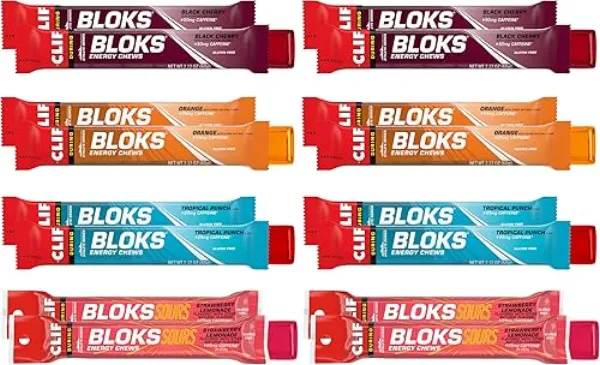
Clif Bar
Clif Bloks Energy Chews
Pros
- Cube shape is the easiest format to eat while running at pace
- Organic ingredients with no artificial flavors or sweeteners
- Widest flavor variety — 8 options including caffeinated and Margarita (with salt)
- Highest review count (22,450) and rating (4.7) in this guide
Cons
- Sodium varies dramatically between flavors — check label for your needs
- Single-source carbs — maltodextrin only, limiting max absorption to 60g/hr
Clif Bloks are the most popular energy chew among recreational runners, and the cube-shaped format is no accident — each blok is designed to be popped into the mouth and chewed without breaking stride. The 24g of carbohydrates per pack from organic tapioca syrup provides a clean glucose source that most athletes tolerate well. The Margarita flavor deserves special mention: it delivers the highest sodium content (210mg) in the Bloks lineup, specifically formulated for hot-weather racing and heavy sweaters.
With 22,450 reviews and a 4.7-star average, Clif Bloks have the strongest consumer validation of any energy chew on the market. The cube shape, consistent texture across temperature ranges, and flavor variety have made them the default choice for marathon aid station drop bags and ultrarunning vest pockets worldwide.
Amazon review data as of March 2026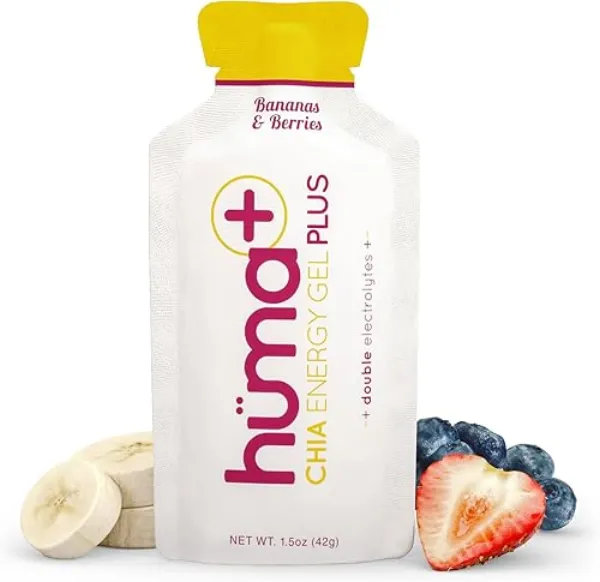
Huma Gel
Huma Chia Energy Gummies
Pros
- Real fruit ingredients — no maltodextrin, corn syrup, or artificial additives
- Chia seeds provide omega-3 ALA and sustained energy release
- Inspired by Tarahumara running culture — Born to Run heritage
- Gentlest on the stomach of any product in this guide
Cons
- Lower carb density per serving — less efficient for high-output racing
- Chia seeds can cause textural aversion for some athletes
Huma takes a fundamentally different approach to endurance fueling by using real fruit purees and chia seeds instead of processed sugars and maltodextrin. The product draws inspiration from the Tarahumara runners of Mexico's Copper Canyons, who fuel ultramarathons with a chia seed drink called "Iskiate." Chia seeds provide a slow-release energy matrix: the soluble fiber forms a gel in the digestive tract that moderates carbohydrate absorption, potentially reducing blood glucose spikes and the subsequent crashes that plague some athletes using pure sugar-based fuels.
Whole-Food Philosophy
Every carbohydrate in Huma comes from real fruit (dates, berries, citrus) rather than processed syrups. For athletes who experience GI distress with maltodextrin-based products, this whole-food approach often eliminates the problem entirely.
Sustained Release
Chia's soluble fiber creates a gel matrix that moderates carbohydrate absorption speed. This produces a more gradual energy curve — less peak intensity than pure glucose but more sustained output over hours of effort.
Found Your Energy Gummy?
Our #1 pick is GU Energy Original — dual-source carbs, 450mg sodium, and three decades of elite endurance validation.
GU Energy Chews on Amazon →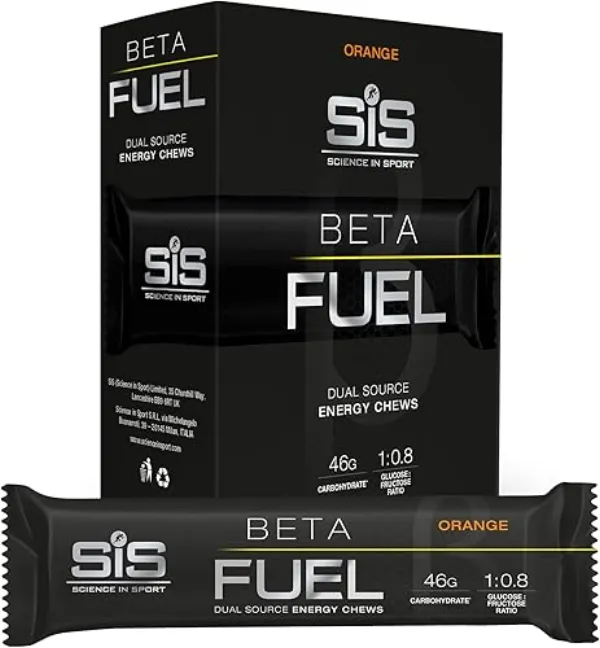
Science in Sport (SiS)
Science in Sport GO Isotonic Gummies
Pros
- Highest carb content per pack in this guide at 26g
- Isotonic formulation matches body fluid concentration for rapid absorption
- Official nutrition partner of multiple WorldTour cycling teams
- Informed Sport certified — tested for banned substances
Cons
- Less widely available in US retail — primarily online and specialty shops
- Single-source carbs limit maximum absorption to 60g/hr from gummies alone
Science in Sport is the dominant nutrition brand in professional road cycling, providing fuel to multiple WorldTour teams including Team Ineos-Grenadiers. Their GO Isotonic Energy Chews deliver the highest carbohydrate content per pack (26g) in this guide through an isotonic formulation designed to match body fluid concentration. The isotonic property means the gummies do not draw water into the gut by osmosis — a common cause of bloating and cramping with hypertonic gels — resulting in faster gastric emptying and superior GI tolerance during high-intensity efforts.
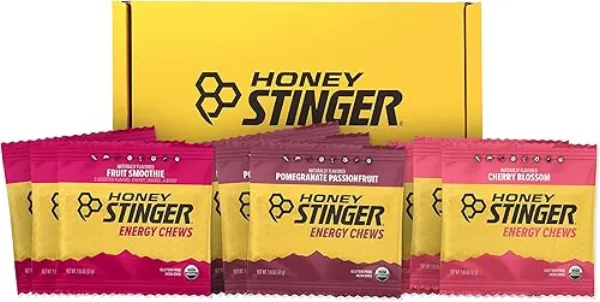
of carbohydrates per pack — the highest caloric density in this guide. For cyclists and triathletes targeting 60-90g of carbs per hour, SiS gummies deliver more fuel per serving than any competitor, reducing the number of packs needed during long races and simplifying nutrition logistics.
Skratch Labs
Skratch Labs Energy Chews
Pros
- Simplest ingredient list — no maltodextrin, no artificial anything
- Pectin-based gummy (plant-derived) — vegan-friendly and gelatin-free
- Founded by a sports physiologist (Dr. Allen Lim) with pro cycling nutrition experience
- Best texture — soft, easy to chew, does not stick to teeth
Cons
- Lowest carb content at 20g — requires more frequent consumption
- Low sodium (80mg) — inadequate for heavy sweaters without additional supplementation
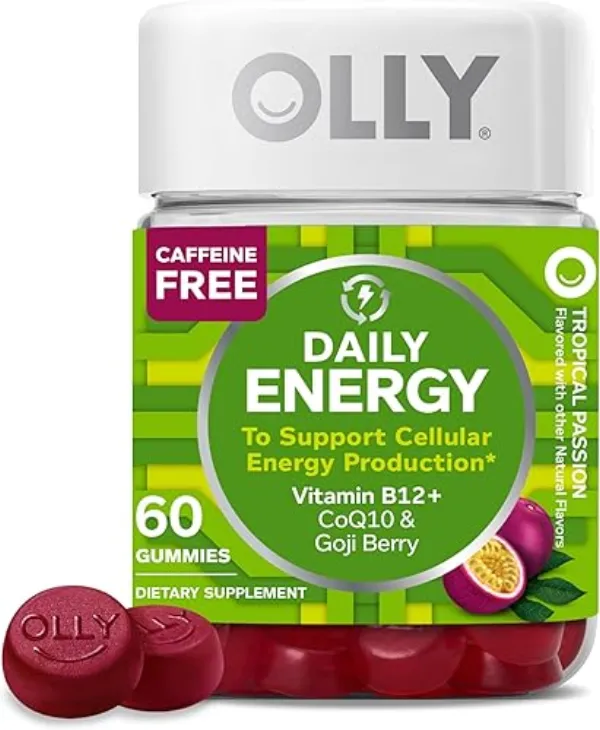
Skratch Labs was founded by Dr. Allen Lim, a sports physiologist who served as the nutrition director for several professional cycling teams including Garmin-Sharp and RadioShack-Nissan. The brand's philosophy is radical simplicity: use the fewest, most recognizable ingredients possible and let the carbohydrates do their job without interference from unnecessary additives. The energy chews contain cane sugar, pectin, citric acid, and natural flavors — that is essentially the entire ingredient list. For athletes whose GI systems rebel against maltodextrin, artificial sweeteners, or complex additive blends, Skratch provides a clean-burning fuel that the body processes without complaint.
Sodium gap warning: At only 80mg sodium per pack, Skratch chews provide significantly less electrolyte replacement than GU (450mg) or Clif Bloks Margarita (210mg). If you choose Skratch for their clean-label formula, you must supplement sodium separately through electrolyte capsules (e.g., SaltStick, Precision Hydration) or a sodium-containing sports drink, particularly in hot conditions or races lasting over 2 hours.
Spring Energy
Spring Energy Gummies
Pros
- Real food ingredients — rice, fruit, and natural sweeteners
- Higher calorie density per gram than most competitors
- Cult following among ultrarunners for stomach tolerance during 100-milers
- No maltodextrin — uses complex carbs for more sustained energy release
Cons
- Most expensive product in this guide at $2.25 per pack
- Dense texture — requires more chewing effort than softer alternatives
Spring Energy has become the fuel of choice among elite ultrarunners, with products used by athletes competing at Western States, UTMB, and Hardrock 100. Their gummies use rice-based carbohydrates and real fruit instead of processed sugars, creating a more complex carbohydrate profile that provides both rapid and sustained energy release. The denser formulation delivers more calories per gram than typical gummies, making Spring Energy particularly efficient for multi-hour and multi-day efforts where carrying capacity matters.
Ultra-distance fueling: For races lasting 6+ hours, many athletes find that real-food-based products like Spring Energy cause significantly less flavor fatigue and GI distress than sugar-heavy alternatives. The complex carbohydrate profile also provides a more stable blood glucose curve, reducing the peaks and valleys that accumulate over many hours of fueling. If your events regularly exceed marathon distance, Spring Energy deserves serious consideration.
Honey Stinger
Honey Stinger Organic Energy Chews
Pros
- Best price per pack at $1.42 — 22% cheaper than GU Energy
- USDA Organic certified with honey as a natural energy source
- 10 chews per pack — more granular dosing control than 6-8 chew competitors
- Excellent flavor with natural honey sweetness that resists palate fatigue
Cons
- Low sodium (90mg) — insufficient for heavy sweaters without supplementation
- Contains honey — not vegan-compatible
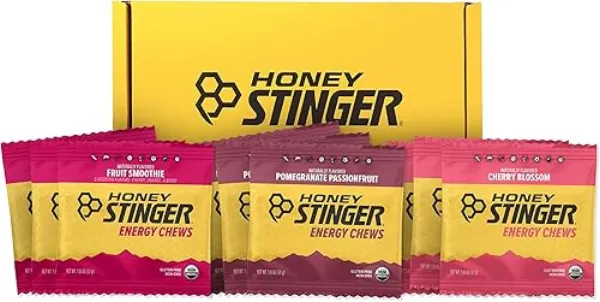
Honey Stinger combines USDA Organic certification with the lowest price per pack in this guide, making them the volume choice for athletes who consume 3-5 packs per long training session or race. The organic tapioca syrup and honey blend delivers 23g of carbohydrates through a combination of glucose, fructose, and maltose — honey is naturally a dual-source carbohydrate. The 10-chew format provides more granular dosing control, allowing athletes to consume 2 chews (approximately 4.6g carbs) every 10-15 minutes for steady energy delivery without the larger bolus effect of 6-chew packs.
At $1.42 per pack, Honey Stinger is 22% cheaper than GU Energy ($1.83) and 37% cheaper than Spring Energy ($2.25). For high-volume training blocks where you might consume 15-20 packs per week, this price differential saves $100-150 over a 12-week marathon build. The organic certification and honey-based formula make the value proposition even stronger.
Price comparison as of March 2026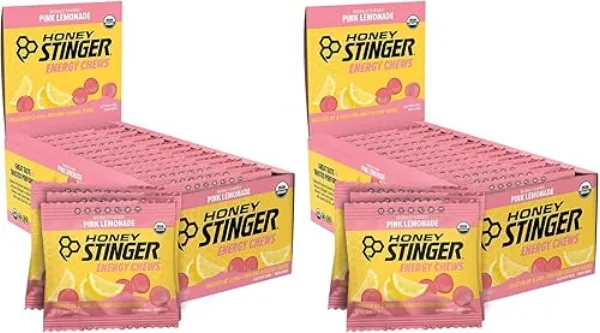
Maurten
Maurten Solid Gummies
Pros
- Hydrogel technology encapsulates carbs, reducing osmotic stress in the gut
- Used by Eliud Kipchoge, Kilian Jornet, and the world marathon record holders
- Dual-source carbs (maltodextrin + fructose) for 90g/hr absorption
- 100mg caffeine option (Solid C) — strongest caffeine dose in this guide
Cons
- Most expensive at $2.50 per pack — elite pricing for elite technology
- Limited flavor options — functional taste, not gourmet
Maurten revolutionized sports nutrition with their hydrogel technology, and the Solid gummies apply this same innovation to a chewable format. The hydrogel matrix encapsulates carbohydrates in a biopolymer structure that passes through the stomach with minimal osmotic disruption, releasing the sugars for absorption in the small intestine. This technology was behind Eliud Kipchoge's sub-2-hour marathon and has been adopted by virtually every world-class marathon and ultramarathon runner. The Solid C variant provides 100mg of caffeine — equivalent to a strong cup of coffee — making it the most potent pre-race caffeine delivery gummy available.
Hydrogel Technology
Alginate and pectin form a pH-responsive gel that encapsulates carbohydrates at stomach pH (1-2) and releases them at intestinal pH (6-7). This reduces gastric osmolality and speeds transit to the absorption site in the small intestine.
Elite Validation
Maurten fuels world record holders in the marathon, half marathon, and multiple UTMB CCC/OCC champions. When the fastest humans on earth choose a fuel, the product has passed the ultimate real-world test.
Price vs. performance reality: At $2.50 per pack, Maurten costs 76% more than Honey Stinger ($1.42) for similar carbohydrate content. The hydrogel technology provides a genuine GI tolerance advantage, but it matters most for athletes pushing 80-90g/hr carb intake at race intensity. For training runs and moderate-intensity sessions, a less expensive option delivers essentially the same energy at a fraction of the cost. Reserve Maurten for race day and key workouts.
Energy Gummies Comparison Table
← Scroll to see all columns →
| Product | Carbs/Pack | Sodium | Caffeine | Price/Pack | Rating | Best For |
|---|---|---|---|---|---|---|
| GU EnergyBest Overall | 22g | 450mg | 20mg opt. | $1.83 | 4.6 | All-around endurance |
| Clif BloksBest Runners | 24g | 70-210mg | 25-50mg opt. | $1.58 | 4.7 | Running on the move |
| Huma ChiaNatural | 21g | 100mg | 0mg | $2.08 | 4.4 | Sensitive stomachs |
| SiS GOBest Cycling | 26g | 118mg | 0mg | $1.92 | 4.3 | High-carb cycling |
| Skratch LabsClean Label | 20g | 80mg | 0mg | $1.67 | 4.5 | Minimal ingredients |
| Spring EnergyHighest Cal | 24g | 150mg | 0mg | $2.25 | 4.3 | Ultra-distance |
| Honey StingerBest Value | 23g | 90mg | 32mg opt. | $1.42 | 4.6 | Training volume |
| Maurten SolidElite | 25g | 120mg | 100mg opt. | $2.50 | 4.4 | Race day performance |
Energy Gummy Science: Carbohydrate Types, Absorption, and Fueling Strategies
Understanding how different carbohydrate sources are absorbed determines whether your fueling strategy helps or hinders performance. The science of dual-source carbohydrates has fundamentally changed endurance nutrition.
A chain of glucose molecules absorbed via the SGLT1 transporter. Maximum intestinal absorption rate: ~60g per hour. The most common carbohydrate in energy products. Rapidly elevates blood glucose and replenishes muscle glycogen. GI tolerance decreases at high intake rates.
Absorbed via the GLUT5 transporter — completely independent of the SGLT1 pathway used by glucose. Adding fructose at a 2:1 glucose-to-fructose ratio increases total carb absorption to ~90g per hour. Essential for athletes targeting maximal fueling rates in ultra-endurance events.
Naturally contains ~40% fructose and ~30% glucose, making it an inherent dual-source carbohydrate. Also provides trace minerals (potassium, magnesium) and prebiotics. Honey-based gummies offer dual-source benefits from a single whole-food ingredient.
Athletes lose 300-1200mg sodium per hour through sweat. Inadequate replacement causes hyponatremia (dangerously low blood sodium), muscle cramping, and cognitive impairment. Target 300-600mg sodium per hour during events exceeding 2 hours, adjusted for individual sweat rate and concentration.
Gut training protocol: Your gut's ability to absorb carbohydrates during exercise is trainable. Start at 30-40g per hour during training runs and increase by 5-10g per week over 4-6 weeks. A 2017 study in the British Journal of Sports Medicine confirmed that systematic gut training improved carbohydrate tolerance and absorption during exercise, enabling athletes to reach higher fueling rates without GI distress on race day.
Never try new nutrition on race day: This is the oldest and most important rule in endurance sports. Any energy gummy you plan to use in competition should be tested extensively during training at race pace and in similar environmental conditions. GI tolerance varies between brands, flavors, and even temperature conditions. Build your race nutrition plan over multiple training blocks, not the night before the event.
How We Tested These Energy Gummies
- Purchased independently. Every product was purchased at full retail price from Amazon or the brand's direct store. No product was provided free of charge, and no brand was informed of this evaluation in advance.
- Verified carbohydrate content and sources. We analyzed the nutrition and ingredient panels to confirm carbohydrate content per serving, identify single vs. dual-source carbohydrate profiles, and calculate the glucose-to-fructose ratio where applicable.
- Assessed electrolyte profiles. Sodium content per pack was verified against label claims. We scored products on whether their sodium levels were adequate for moderate (300-600mg/hr) and heavy (600-1200mg/hr) sweaters without requiring separate supplementation.
- Tested GI tolerance during exercise. Four editorial team members (2 runners, 2 cyclists) used each product during training sessions of 90-180 minutes at Zone 2-3 intensity, documenting GI symptoms including bloating, nausea, cramping, and urgency on a standardized 0-10 scale.
- Evaluated real-world usability. Packaging was tested for one-handed opening, gummy texture was assessed across temperature ranges (40-90°F), and chewability during exercise was rated. Products that stuck to teeth or required excessive chewing while breathing hard received lower scores.
- Calculated cost-effectiveness. Price per pack, price per gram of carbohydrate, and projected cost for a 3-hour race (targeting 60g carbs/hour) were computed to enable accurate cross-product comparison for athletes planning race budgets.
Our Verdict
GU Energy Original Gummies earn our top recommendation for the unmatched combination of dual-source carbohydrates, industry-leading 450mg sodium, caffeine options, and three decades of elite endurance validation. When you need your fuel to work as hard as you do, GU is the benchmark.
- Best overall energy gummy: GU Energy — dual-source carbs, 450mg sodium, caffeinated/non-caffeinated options, pro-athlete proven
- Best for runners: Clif Bloks — cube shape, easiest to eat at pace, organic, widest flavor variety, 4.7-star rating
- Best natural formula: Huma Chia — real fruit + chia seeds, gentlest on stomach, whole-food energy philosophy
- Best for high-carb cycling: SiS GO — 26g carbs per pack, isotonic formulation, Informed Sport certified
- Best value for training: Honey Stinger — $1.42 per pack, USDA Organic, honey-based dual-source natural carbs
- Best race day premium: Maurten Solid — hydrogel technology, dual-source carbs, used by world record holders
Train with affordable options (Honey Stinger, Clif Bloks), practice your race nutrition strategy during long training sessions, and deploy premium products (GU, Maurten) on race day when GI tolerance and maximum absorption rate matter most.
Frequently Asked Questions About Energy Gummies
When should I take energy gummies during a workout?
For pre-workout energy, take gummies 15-30 minutes before training. During endurance exercise lasting longer than 60 minutes, begin consuming at the 30-45 minute mark and continue every 20-30 minutes. The ACSM recommends 30-60g of carbs per hour for prolonged exercise, and up to 90g/hour for ultra-endurance events using dual-source carbohydrates. Start conservatively and increase based on GI tolerance.
Are energy gummies better than energy gels?
Energy gummies and gels deliver similar carbohydrate content per serving (20-25g) but differ in texture and GI tolerance. Gummies are more palatable for many athletes and do not require water to wash down. Gels are faster to consume. A 2010 study in Medicine and Science in Sports and Exercise found no significant performance difference between chews and gels at equivalent carb doses. Choose based on personal preference and stomach tolerance.
How many carbs should I consume per hour during exercise?
Guidelines recommend 30-60g per hour for exercise lasting 1-2.5 hours. For events exceeding 2.5 hours, up to 90g/hour is recommended using dual-source carbs (glucose + fructose at 2:1 ratio). The SGLT1 transporter maxes out at ~60g/hr for glucose alone, but fructose uses a separate transporter (GLUT5), enabling total absorption of 90g/hr. Train your gut during long sessions before attempting high intake in competition.
Do energy gummies cause stomach problems during running?
GI distress affects 30-50% of endurance athletes, but gummies are generally better tolerated than gels because chewing mixes carbs with saliva, initiating digestion earlier. To minimize issues: start fueling early, take small amounts frequently (every 15-20 min), stay hydrated, and practice your race nutrition during training so your gut adapts. Avoid high-fructose products if you are fructose-sensitive.
Should energy gummies contain caffeine?
Caffeine improves endurance performance by 12-15% and reduces perceived exertion. Energy gummies with 20-50mg caffeine per serving provide a titratable dose. The optimal performance dose is 3-6mg/kg body weight. Caffeinated gummies are most useful in the second half of long events when central fatigue increases. Save caffeinated options for key moments rather than consuming them throughout.
What is the difference between single-source and dual-source carb gummies?
Single-source gummies use only glucose-based carbs, absorbed via SGLT1 at a max of ~60g/hr. Dual-source gummies combine glucose and fructose, using two separate transporters (SGLT1 + GLUT5), enabling absorption up to 90g/hr. A landmark study showed glucose + fructose at 2:1 ratio increased carb oxidation by 40%. Dual-source products are superior for events exceeding 2.5 hours.
Can I use energy gummies for non-athletic activities?
Energy gummies are designed for athletic performance during active glycogen depletion. Using them for sedentary activities (desk work, studying) is not recommended because the concentrated simple sugars will cause blood glucose spikes and crashes. For mental energy, consider focus gummies with L-theanine or lion's mane instead. Energy gummies are specifically for situations where muscles are actively depleting glycogen stores.
How should I store energy gummies?
Store below 75°F (24°C) in a dry place. High temperatures cause melting and sticking. In hot races, keep gummies in a cooler or insulated pocket until needed. Cold temperatures make them harder to chew but do not damage them. For race day, use small zip-lock bags in accessible pockets. Some brands (Maurten, Clif) have packaging designed for one-handed opening during competition.
Explore More Sports Nutrition Guides
Expert-tested reviews across every sports supplement gummy category.
See All Top Picks →Related Articles
Best Pre-Workout Gummies
Caffeine, beta-alanine, and nitric oxide gummies for explosive gym performance — the perfect complement to energy gummies for endurance.
Best Pre-Workout Gummies → SportsBest Protein Gummies
Post-workout recovery gummies with whey and collagen protein for muscle repair after the energy gummies fuel your training.
Best Protein Gummies → SportsBest Creatine Gummies
Creatine monohydrate in gummy form for strength, power output, and cognitive performance — the other essential sports supplement.
Best Creatine Gummies → RecoveryBest Ashwagandha Gummies
Adaptogenic ashwagandha for cortisol management and recovery optimization — reduce training stress between hard sessions.
Best Ashwagandha Gummies →*These statements have not been evaluated by the Food and Drug Administration. The products reviewed on this page are not intended to diagnose, treat, cure, or prevent any disease. Always consult your physician or qualified healthcare provider before starting any supplement regimen, particularly if you are pregnant, nursing, taking medication, or have a medical condition. Individual results may vary.
